


Skip to content
Open source ยท Self-hosted Built on ITFlow

Open-source IT operations software.

Help desk, assets, docs and credentials for IT teams and MSPs. Free, GPL-3.0, on your own servers.

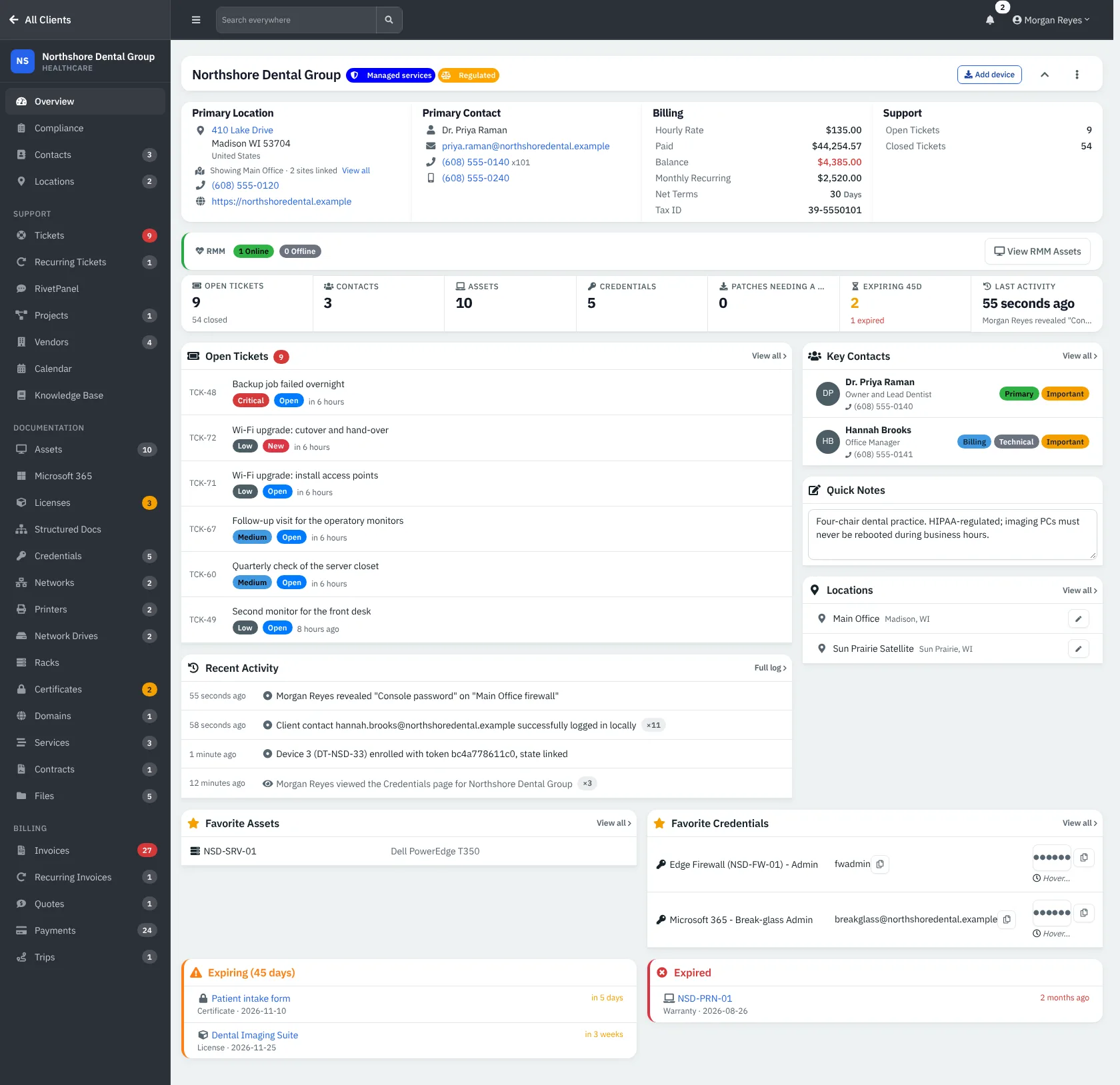
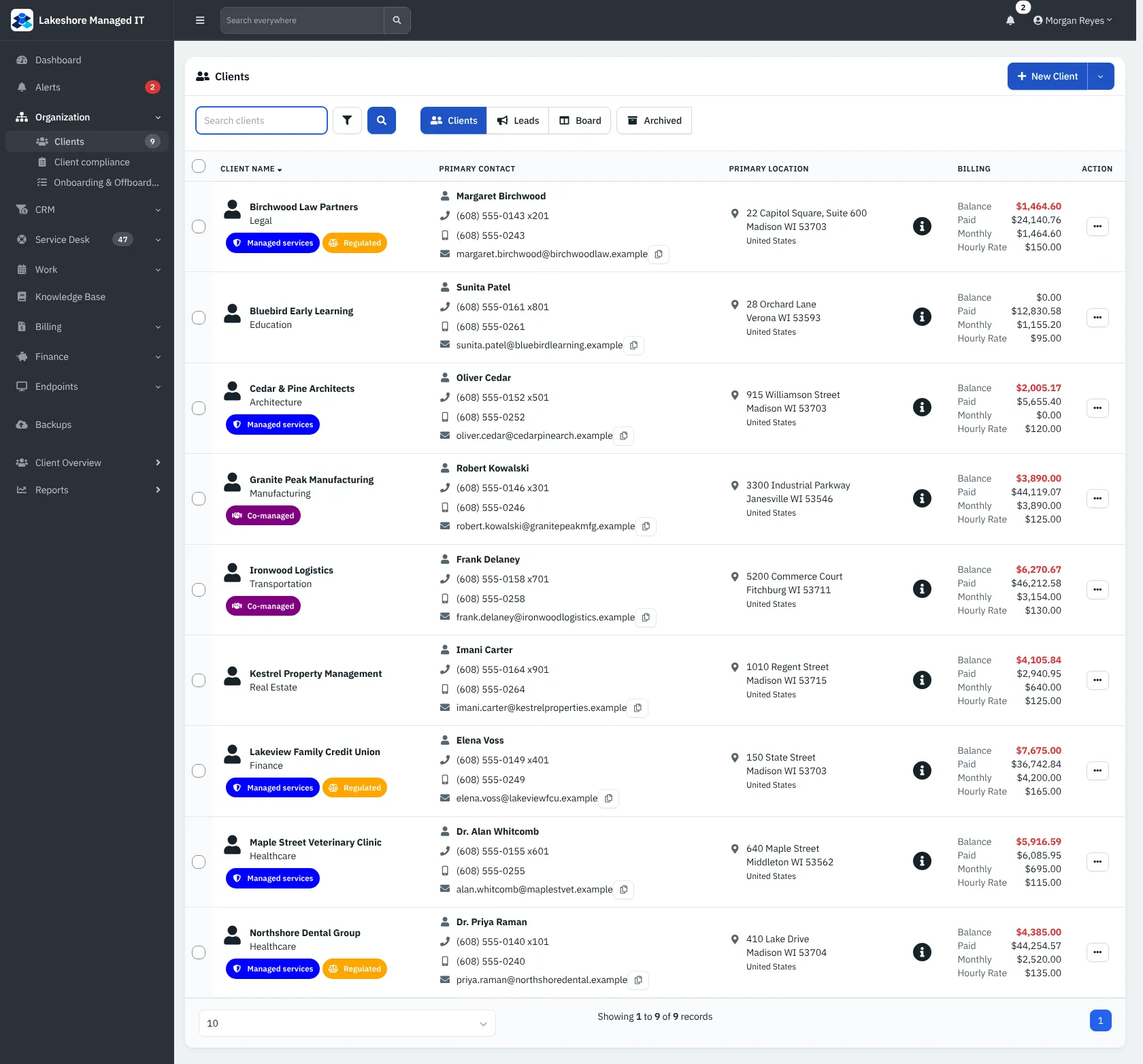
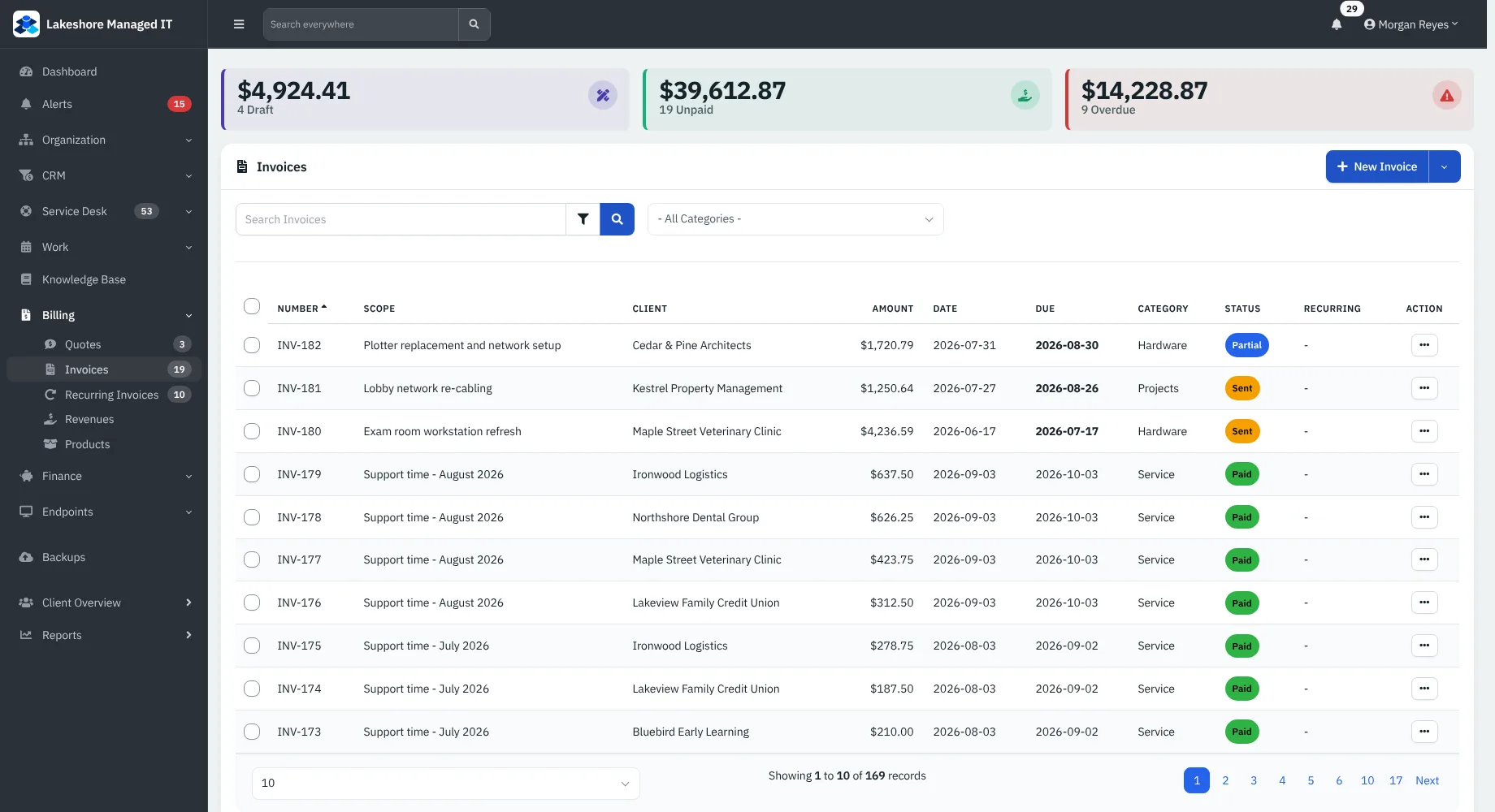
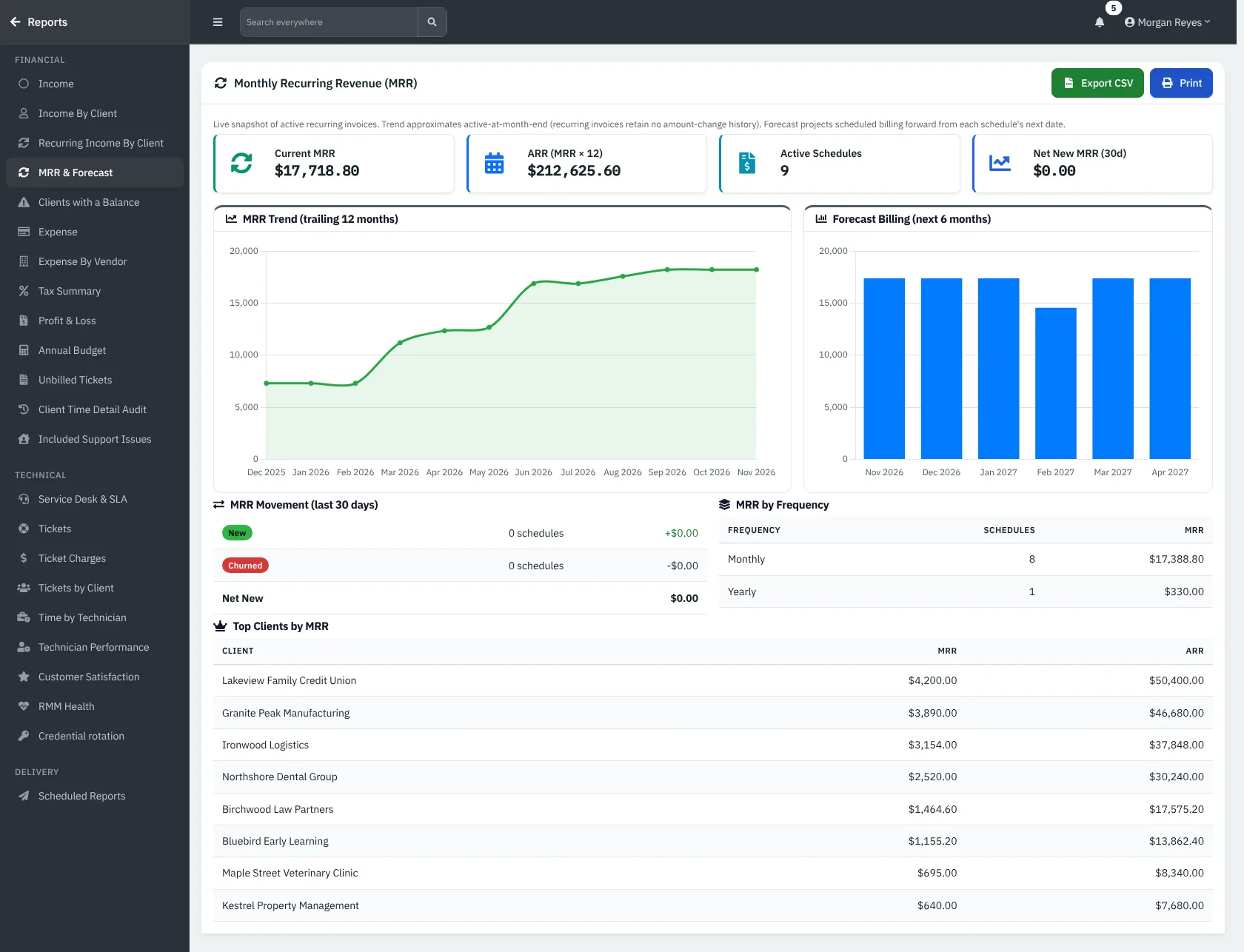
Real screens from the public demo, with fictional data. See all screenshots

Production release on January 1, 2027. All Rivet products are in beta until then. See the roadmap.

Live from GitHub

28
releases in the last 30 days
v26.10.88
latest release
2h
since the last code push
2 of 2
demo servers online
GPL-3.0, no per-seat fees
FreeGPL-3.0, no per-seat fees
Your data, your servers
Self-hostedYour data, your servers
Webhooks and 113 events
24 platformsWebhooks and 113 events
Apps for technicians
iOS & AndroidApps for technicians

Two products. One foundation.

RivetIT

Built for internal IT Beta

Help desk, assets, documentation, credentials, automation and training for one organisation, on your own server.

  • Service desk, assets and documentation
  • Credential vault, event rules and webhooks
  • Microsoft 365, Odoo and RMM integrations
  • Employee training (LMS) with kiosks
RivetMSP

Built for service providers Beta

Multi-client ticketing, dispatch, documentation, contracts with SLAs and billing for managed service providers.

  • Multi-client ticketing and dispatch calendar
  • Contracts with SLA tracking and billing
  • Documentation, credentials and assets per client
  • Webhooks and event rules for your other tools
  • Android app for field technicians

From a message to a fix, and on to your other tools

From the first message to the finished work, with the busywork handled on the way.

  1. Step 1

    It arrives

    E-mail to ticket, the portal, the API or an RMM alert.

    • E-mail
    • Portal
    • API
    • RMM alert
  2. Step 2

    It is triaged

    Category, priority and an SLA clock are set, and automation rules assign and notify.

    • SLA
    • Rules
  3. Step 3

    It is worked

    A technician logs time, adds notes, uses canned responses and fills in worksheets.

    • Time
    • Notes
    • Worksheets
  4. Step 4

    It is closed and reported

    Close it out, then see the work in the reports.

The same events can leave the building, shaped and signed for whatever receives them.

  1. Step 1

    An event fires

    Choose events from a searchable picker, with group wildcards.

    • 113 events
  2. Step 2

    It is formatted

    13 payload formats, or your own template with safe placeholders.

    • JSON
    • Slack
    • Teams
    • Custom
  3. Step 3

    It is signed

    Bearer, basic, custom header or a signed timestamp, with verification snippets in 5 languages.

    • HMAC
    • Replay-safe
  4. Step 4

    It is delivered

    Sent with retries, to one of 24 ready-made platforms.

    • n8n
    • Zapier
    • Make
    • Discord
    • Home Assistant
    • +19

Everything an IT team reaches for

Ticketing

Statuses, priorities, assignment, watchers, time tracking and canned responses, in list and Kanban views.

Event rules

A When, If, Then builder on 113 events, with a safe test drawer, run history and a loop guard.

Asset management

Computers, servers, network gear and mobile devices, with warranty, software, domains, certificates and racks.

Knowledge base

Searchable how-to articles. RivetIT adds version history, imports and portal visibility.

Credential vault

Encrypted credentials with TOTP, reveal logging and rotation reports.

Webhooks

24 ready-made platforms, 13 formats, signed delivery and retries.

A look inside

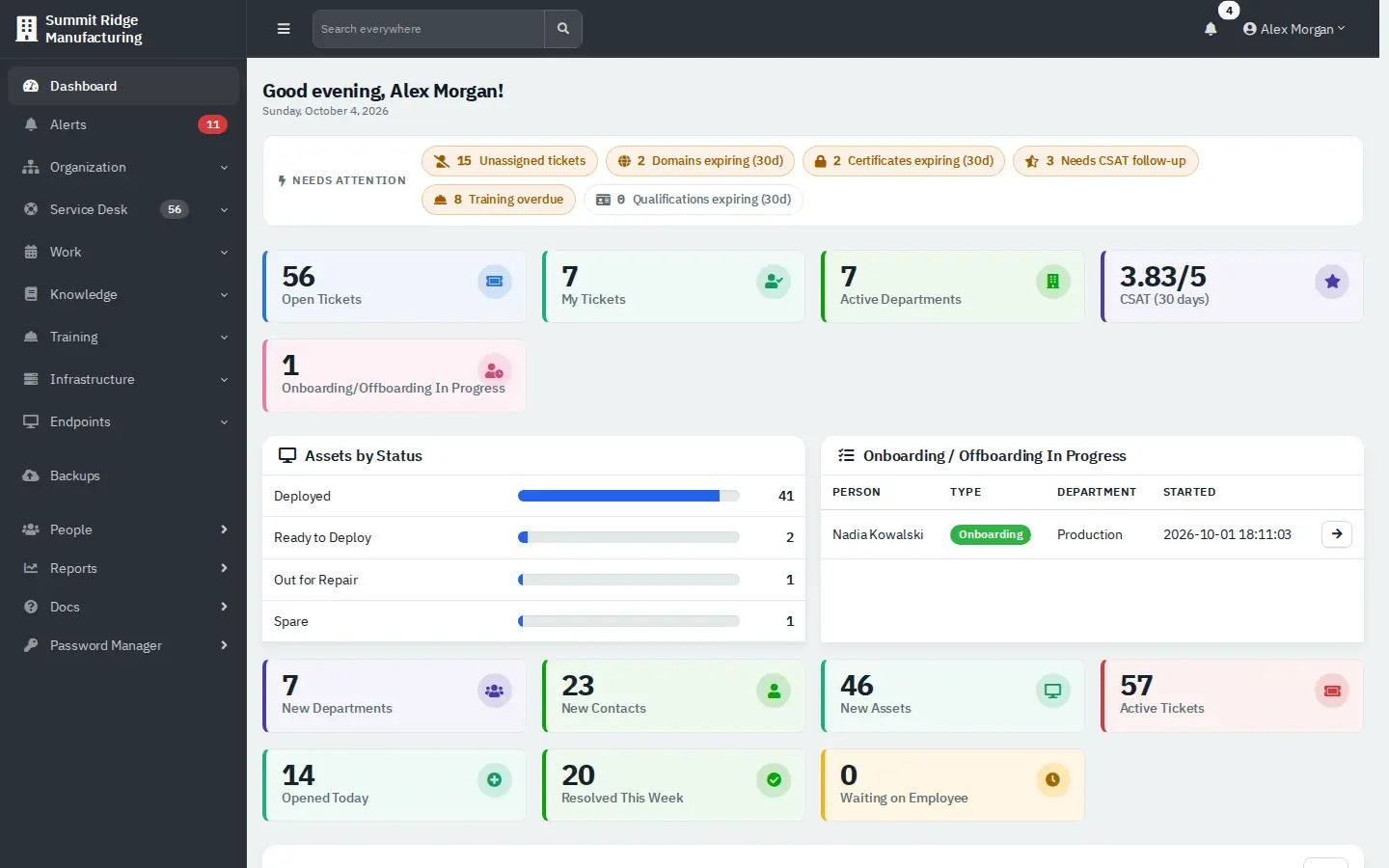
Service desk dashboard

RivetIT

Open tickets, alerts and what needs attention, the moment you sign in.

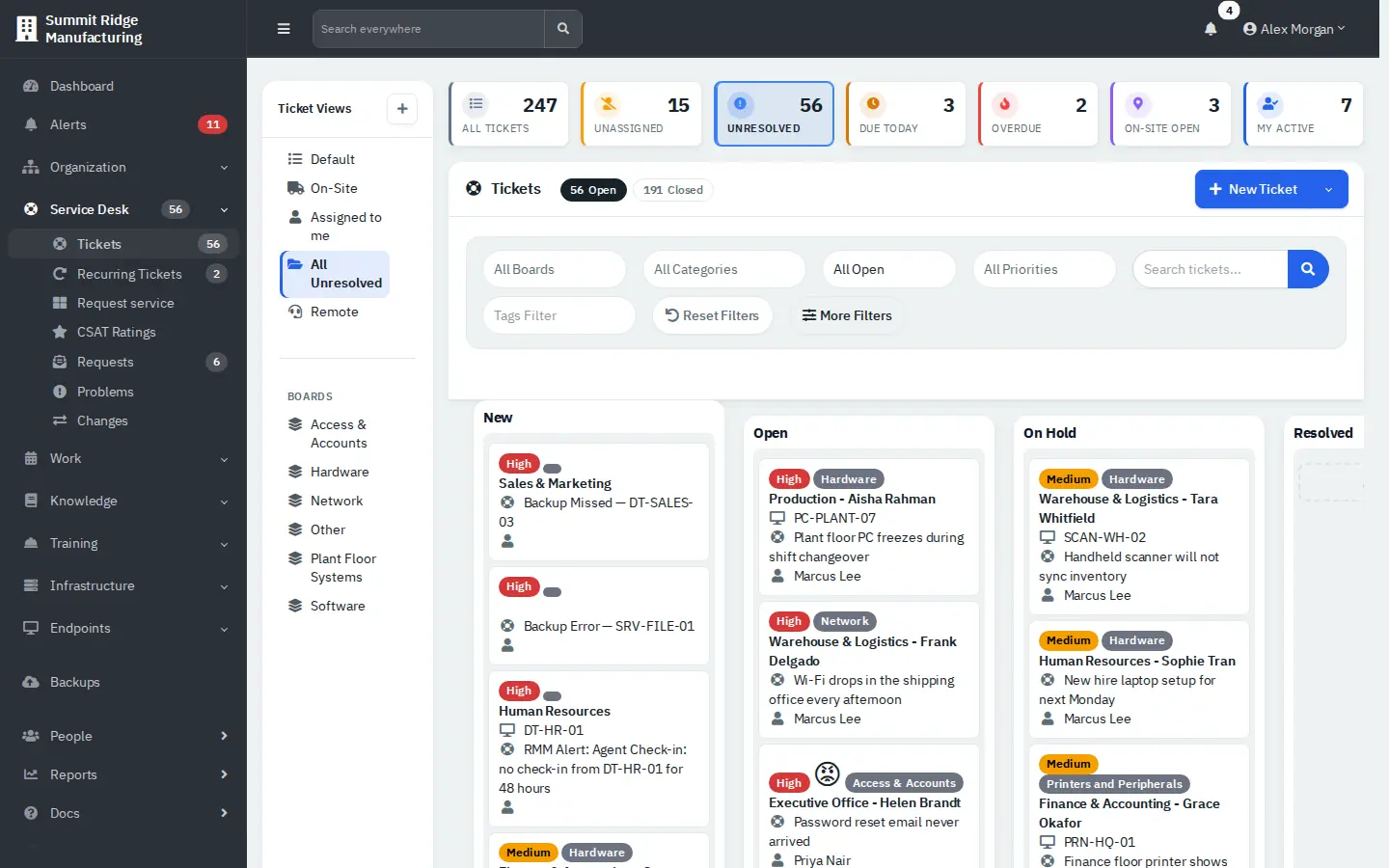
Ticket Kanban

RivetIT

Move tickets between statuses on a board, with priority and department at a glance.

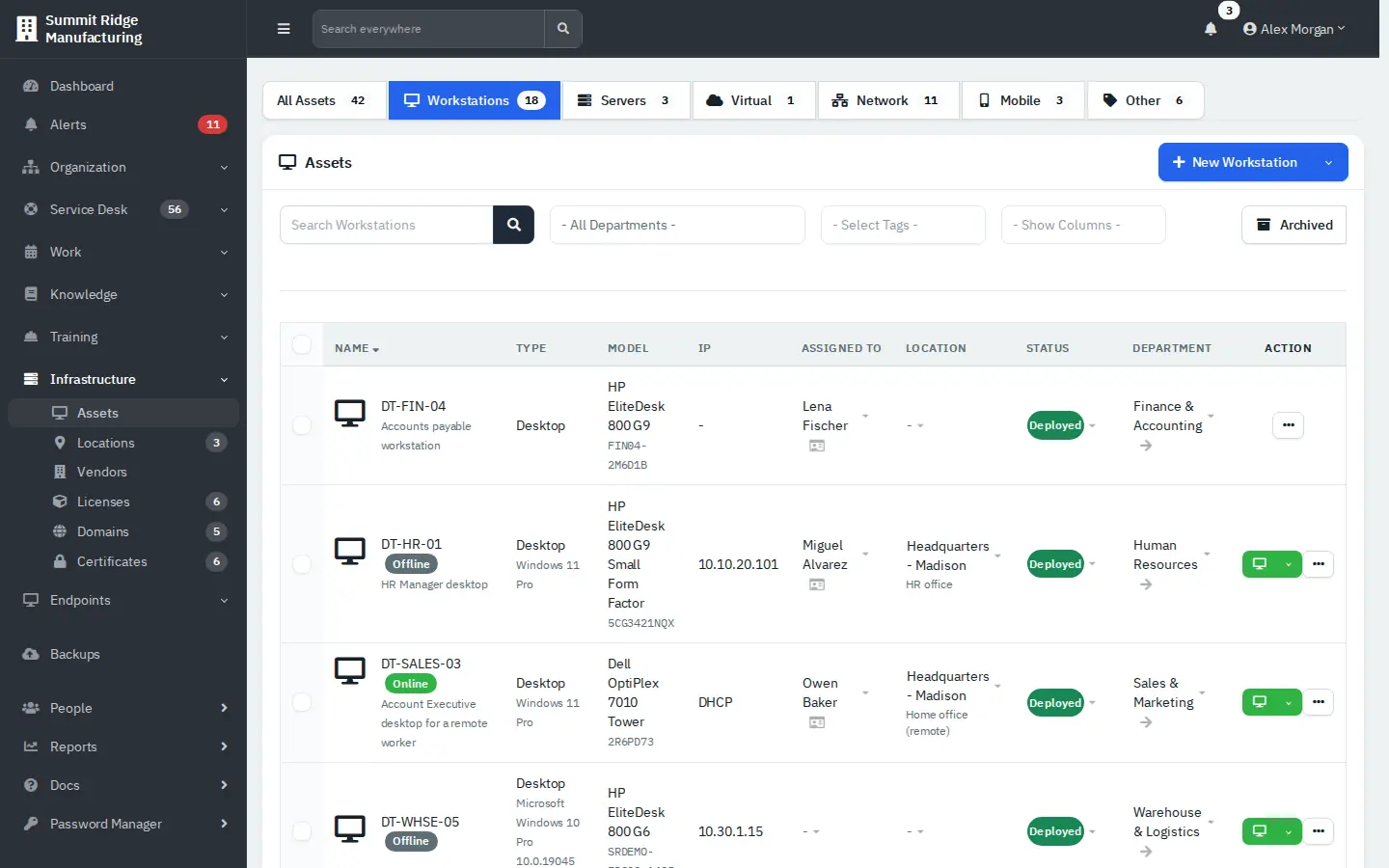
Asset inventory

RivetIT

Workstations, servers, network gear and more, filterable by type and department.

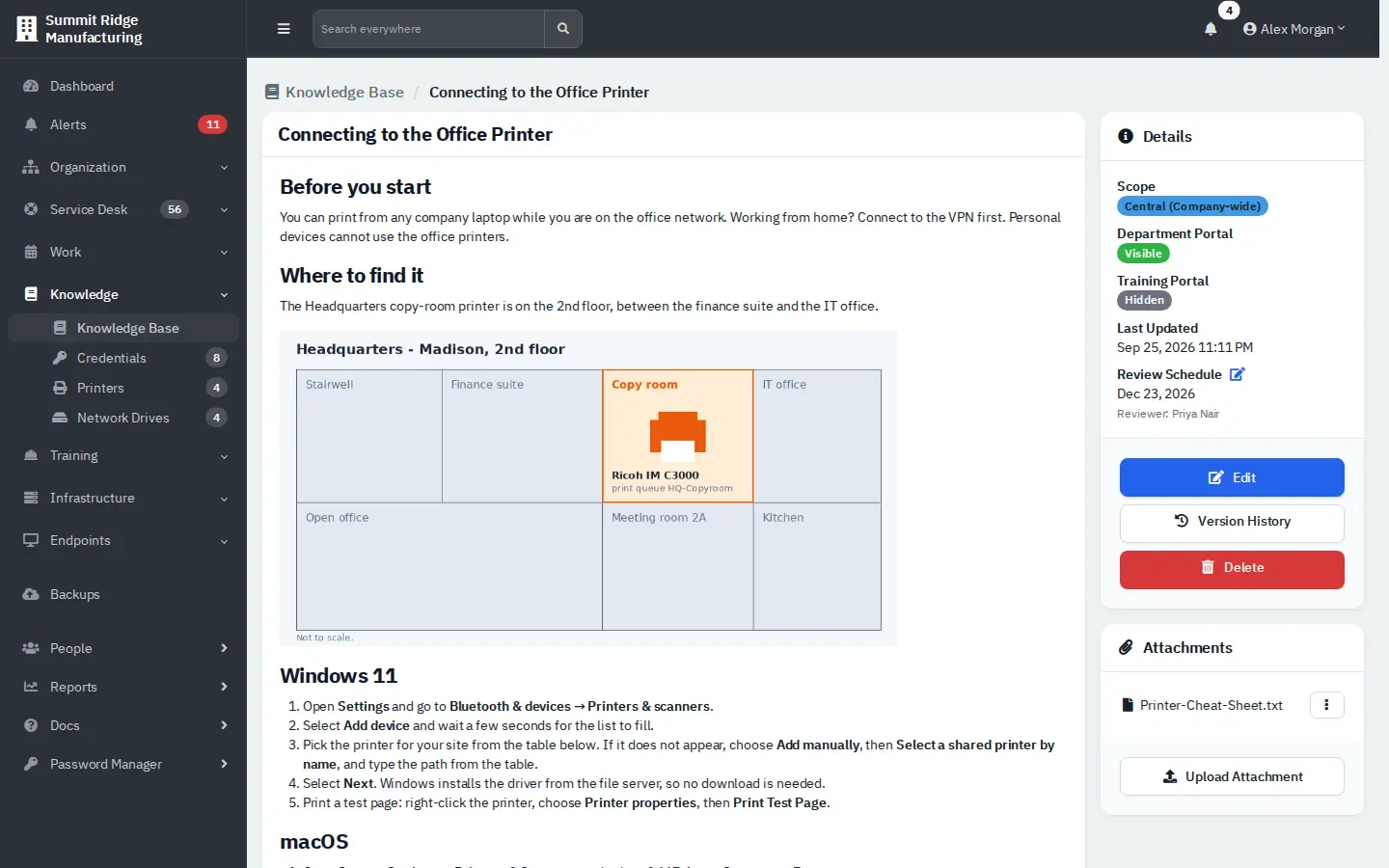
Knowledge base article

RivetIT

Formatted how-tos with attachments, version history and portal visibility.

Your IT records, on your infrastructure

Self-hosted

Tickets, docs and credentials stay on your servers.

Open source

Read, audit and extend the code. GPL-3.0.

No lock-in

Your data lives in a database you own.

Built for IT

Shaped by how IT teams and MSPs really work.

Questions

Is it really free?

Yes. RivetIT and RivetMSP are open source under GPL-3.0, with no per-seat or per-device fees. You pay only for your own server.

What is the difference between RivetIT and RivetMSP?

RivetIT is for one organisation: departments, locations and employees. RivetMSP is for service providers who manage many clients, with contracts, SLAs and billing.

Where is my data stored?

On your own server, in a database you own. Nothing is sent to us.

Why is there a Rivet Core?

RivetIT and RivetMSP need the same plumbing: audit, background jobs, webhooks, automation and more. We keep it in one shared library, so a fix or feature lands in both products and we never build it twice.

Is it an ITFlow alternative?

Both products are built on ITFlow. They add event rules and webhooks, Android apps, company sign-in, RMM and Microsoft 365 integrations and hardened installers.

Is it ready for production?

Both are in beta. Production release is planned for January 1, 2027. You can run them today and try the live demos.

Can AI assistants and search engines read this site?

Yes. Everything is crawlable, and a plain-text summary is at /llms.txt.

We build on ITFlow, the free and open-source IT documentation, ticketing and asset management platform.

Try it, then run it yourself

Free to use. Open the live demo or install it in minutes.